Inquiry question : Why should we remember the 1950s and early 1960s today? (Hock Lee Bus Riot )
The events between the 1950s and early 1960s are important to remember as it has an impact to the current generation. It also allows us to learn many morals and values from the incidents that took place during the generation of our ancestors. In this case, we should remember the Hock Lee Bus Riot incident as it has shows how we should treat each and every one in Singapore equally regardless of race, language and religion.
To begin with, remembering the Hock Lee Bus Riot will let employers learn that the rights of the workers or bus drivers should be protected. It is because “The Hock Lee Bus Strike, like other strikes in this period, occurred because workers were being exploited and tried to protect themselves by forming a union to negotiate for better conditions.” Moreover, “Singapore also had massive unemployment” as “Employers simply could hire and fire at will, knowing they could easily find new workers.” This happened all because the employers did not protect the rights of the workers. For instance, in 2012, there was an incident where Singapore Mass Rapid Transport ( SMRT ) bus drivers protested for a higher pay by refusing to go to work, as they were unhappy about the recent pay increase that Malaysian drivers had received. This lead to them in thinking that they were being treated unfairly. Hence, from this incident, we learn that the workers’ right should be protected.
Secondly, remembering the Hock Lee Bus Riot will let the current generation know the importance of transport in Singapore. It is because “The strikers picketed and attempted to stop the buses from leaving the depots by forming human barriers which cause the entire transport system to be paralyzed...” This shows that bus could not leave and therefore, this will lead to people having to find other means to travel around Singapore. Some might even be late for work as their means of transport is disrupted. For instance, nowadays, transport in Singapore is essential for everyone. Without bus drivers, there will not be any transport and school students will not be able to go to school and also adults, they will not be able to head to work without transport. It will also result in no economy prosperity. In order to prevent such incident from happening, we have to make sure that the drivers should be well-paid and well-treated so that such riot will not happen again. Therefore, by remembering the Hock Lee Bus Riot, we will know the importance of transport and prevent making the same mistakes again.
Thirdly, by remembering the Hock Lee Bus Riot, we should learn that we should treat everybody, even if they have different educational background, equally. It is because quoted from Dr Thum, “The Hock Lee Bus Strike can be seen as a demonstration of the dissatisfaction the Chinese-educated community had for the discriminatory of the policies implemented by the British colonial government.” This shows that if we do not treat people equally, riot may occur as an act of grieving. For instance, if a bus driver finds that he or she is being treated unfairly, he will create trouble by asking his colleagues to protest together, making the company or even the country having difficulties. In worst scenarios, riots may happen. This also causes the country’s reputation to fall if words get spread to other countries that Singapore had treated different kinds of people differently in an unfair manner. Therefore, from the Hock Lee Bus Riot, we learn that every single person should be treated unbiasedly and fairly.
In conclusion, we can learn a lot of the lessons from the Hock Lee Bus Riot. If we look into the details of the strike, there are many things that have the potential to take place, if we refuse to realize that the rights of the drivers should be protected, the treatment that they should receive, as these will let the current , or even the further generation to know the importance of transport in Singapore . Consequence of not learning any moral lessons is shown in the Hock Lee Bus Riot. Thus , as the younger generation of the nation, we should study the cases and learn from every single detail of the incident, in order to develop the country into a peaceful nation with harmony.
Monday, 25 August 2014

Friday, 22 August 2014
Blog Post 3: Sources for Hock Lee Bus Riots
| Number | Type of source | Citation |
| 1. | Textual Source | Stephanie Ho (6 August 2014). Hock Lee bus strike and riot. Retrieved 22 August 2014 from http://eresources.nlb.gov.sg/infopedia/articles/SIP_4_2005-01-06.html |
| 2. | Pictorial Source | Rally of bus drivers by union leaders, 12/05/1955. (12 May 1955). Taken from https://encrypted-tbn2.gstatic.com/images?q=tbn:ANd9GcRbSu_9dToXiRlQI0MzekSQoCL-hsJhe4SGWeWqiT3ioRHbTV0MNw Taken (22 August 2014) |
| 3. | Textual Source | Liu Hong and Wong S.K. (2004). Singapore Chinese Society in Transition: Business, Politics, and Socio-Economic Change, 1945-1965. Peter Lang Publishing Inc, New York |
| 4. | Textual Source | Historian Dr Thum Pingtjin’s exclusive interview with TODC. Retrived 17 August 2014 from http://www.theonlinecitizen.com/2014/02/hock-lee-bus-riots-fact-or-fiction-by-cna-part-2/ |
| 5. | Textual Source | Lawrence Loo T.H. (2004) A Student’s Experience During The Hock Lee Bus Riots (Selected History Topics for Pimary Social Studies Teaching) Retrived 17 August 2014 from http://www.hsse.nie.edu.sg/staff/blackburn/oralhistorythe_hock_lee_bus_riots.doc |
| 6. | Pictorial Source | Hock Lee Bus Riot, 12 May 1955 (12 May 1955) The Ngee Ann Story. Taken (21 August 2014) |
| 7. | Textual Source | Lawrence Loo T.H (2004) A Student’s Experience During The Hock Lee Bus Riots (Selected History Topics for Pimary Social Studies Teaching) Retrived 17 August 2014 from http://www.hsse.nie.edu.sg/staff/blackburn/oralhistorythe_hock_lee_bus_riots.doc |
| 8. | Textual Source | Lawrence Loo Teck Ho (2004) A Student’s Experience During The Hock Lee Bus Riots (Selected History Topics for Pimary Social Studies Teaching) Retrived 17 August 2014 from http://www.hsse.nie.edu.sg/staff/blackburn/oralhistorythe_hock_lee_bus_riots.doc |
| 9. | Pictorial Source | Riot Police Attending to Injured Victims at Hock Lee Bus Riots (12 May 1955) http://www.nas.gov.sg/archivesonline/photographs/record-details/35a45dd5-1162-11e3-83d5-0050568939ad Taken (22 August 2014) |
| 10. | Pictorial Source | Bus drivers protesting (12 May 1955) https://encrypted-tbn2.gstatic.com/images?q=tbn:ANd9GcQwYNbH4q9cZxkpJkvYuv_u_vsDG0fWHIsBoucFspX8FrrWxjhw Taken (22 August 2014) |
| 11. | Pictorial Source | Riot police on standby (12 May 1955) https://encrypted-tbn3.gstatic.com/images?q=tbn:ANd9GcSYkrCNmBvUN7dAkEbAEq3Ds-uidsiTPBqiup8JpOJ47gLpc30Tsw Taken (22 August 2014) |
Source 1:
"The riot resulted in four people dead and 31 people injured. Corporal Andrew Teo Bok Lan of the Volunteer Special Constabulary was beaten to death and his car overturned and burned. Detective Corporal Yuen Yau Pang died from injuries sustained after the vehicle he was in was similarly attacked. Other victims included American press correspondent Gene Symonds and a 16-year-old Chinese student, Chong Lon Chong, who suffered a gunshot wound. It was believed that the student had been paraded around for several hours before he was sent to the hospital. By then, it was too late for his life to be saved."
Source 2:
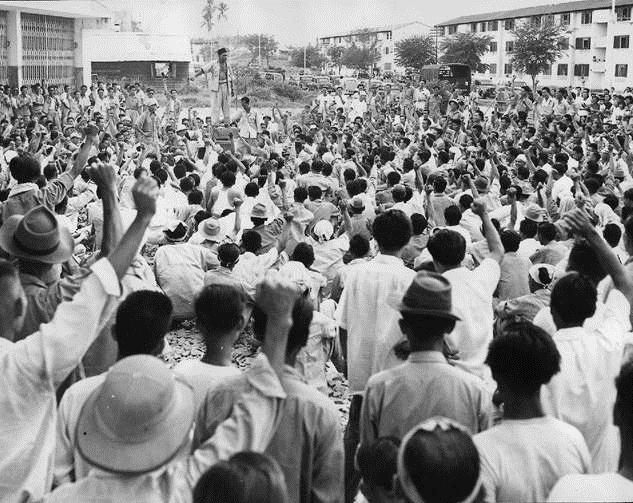 .
.
Source 3:
"Third, the Hock Lee Bus Strike can be seen as a demostration of the dissaisfaction the Chinese-educated community had for the doscriminatory of the policies implemented by the British colonial government. The emergence of the Labour Front gave them an opportunity to let out such unhappy sentiments. Under deliberate provocation and encouragement, the anti-colonialism emotions in the Chinese-eductaed community were intense by mid-1955."
Source 4:
"The Hock Lee Bus Strike, like other strikes in this period, occurred because workers were being exploited and tried to protect themselves by forming a union to negotiate for better conditions. At this time, there were few legal protections for workers. Singapore also had massive unemployment. Employers simply could hire and fire at will, knowing they could easily find new workers. Unions were the only option workers had to protect themselves. But the manager of Hock Lee responded to the union by firing all the workers. The workers were thus forced to strike, or become jobless."
Source 5:
"It was terrible; there were casualties in the riot if I remember correctly. And I felt that they were very pitiful, due to poor welfare of long hours of work and low pay that they received from their employers. There were some students in my school volunteered to help the workers, I volunteered myself as well. What we did was to collect money from other students who wanted to help but were unable to do so since their parents forbid them, so the only way they could help was to donate money. We also collected some biscuits and ration for them and gave it to them when we went onsite to the front gate of Hock Lee Bus Company where the riot was."
Source 6:

Source 7:
"The strikers picketed and attempted to stop the buses from leaving the depots by forming human barriers which cause the entire transport system to be paralysed and also went on a hunger strike. To support the strikers, students from the Chinese middle school came in busloads, and joined the strikers. They organised donation drives, brought food and money, and even entertained the workers with songs and dances."
Source 8:
"The workers joined the Singapore Bus Workers’ Union (SBWU) headed by Fong Swee Suan, as they believed that the union will negotiate better welfares and benefits for them. On April 1955, the services of bus transport were severely disrupted paralysed as buses were prevented from leaving as the strikers formed human barriers by sitting on the ground. Madam Ng also mentioned that the workers had been through hunger strike."
Source 9:

Source 10:
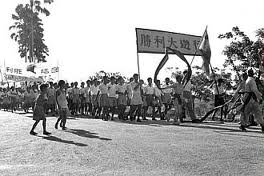
Source 11:
Thursday, 21 August 2014
Blog Post 2: Journal
Date: 15 August 2014
Time: 13.30-14.30
Venue: School concourse
Members present: Ci En, Nicole, Yating, Andre
Members absent: none
Issues discussed: significant events happened on Hock Lee Riots (eg. Chinese-educated students locked themselves in the classroom)
Plan of action: - Research on textual sources of the Hock Lee Bus Riots
Time: 13.30-14.30
Venue: School concourse
Members present: Ci En, Nicole, Yating, Andre
Members absent: none
Issues discussed: significant events happened on Hock Lee Riots (eg. Chinese-educated students locked themselves in the classroom)
Plan of action: - Research on textual sources of the Hock Lee Bus Riots
-Analyzing the sources to prepare for 'Compare and Contrast' of sources
Date: 19 August 2014
Time: 13.30-15.30
Venue: 2 Courage classroom
Members present: Ci En , Nicole, Yating, Andre
Members absent : none
Issues discussed:- Finding of textual sources on Hock Lee bus riot
- Finding of pictorial sources on Hock Lee bus riot
Plan of action: -Analyses sources with the method of 'peel' as well as techniques learned from lessons
Date: 21 August 2014
Time: 13.30-14.30
Venue: School Computer Lab 4
Members present: Ci En , Nicole, Yating, Andre
Members absent : none
Issues discussed: - post on compare and contrast, on sources about political repression (Ci En & Yating)
-essay of the project (Nicole)
-finding on pictorial sources on Hock Lee Bus Riots
Action plan: -finding of pictorial sources of Hock Lee bus riot
-arrange sources found on blog
-writing of reflection essay
Date: 19 August 2014
Time: 13.30-15.30
Venue: 2 Courage classroom
Members present: Ci En , Nicole, Yating, Andre
Members absent : none
Issues discussed:- Finding of textual sources on Hock Lee bus riot
- Finding of pictorial sources on Hock Lee bus riot
Plan of action: -Analyses sources with the method of 'peel' as well as techniques learned from lessons
Date: 21 August 2014
Time: 13.30-14.30
Venue: School Computer Lab 4
Members present: Ci En , Nicole, Yating, Andre
Members absent : none
Issues discussed: - post on compare and contrast, on sources about political repression (Ci En & Yating)
-essay of the project (Nicole)
-finding on pictorial sources on Hock Lee Bus Riots
Action plan: -finding of pictorial sources of Hock Lee bus riot
-arrange sources found on blog
-writing of reflection essay
Date: 22 August 2014
Time : 0900-10.00
Venue: school computer lab 4
Members present: Ci En , Nicole, Yating, Andre
Members absent : none
Issues discussed: - rearrangement of sources on blog (Ci En)
-writing of reflection on Inquiry Questions (Nicole) :
('Why should we remember the events that took place in the 1950s to 1960s?' and 'Why should we remember the 1950s and 1960s today?')
- finding of pictorial sources (Yating & Andre)
Plan of action: -Working on Post 1 (compare and contrast of sources A and B)
Time : 0900-10.00
Venue: school computer lab 4
Members present: Ci En , Nicole, Yating, Andre
Members absent : none
Issues discussed: - rearrangement of sources on blog (Ci En)
-writing of reflection on Inquiry Questions (Nicole) :
('Why should we remember the events that took place in the 1950s to 1960s?' and 'Why should we remember the 1950s and 1960s today?')
- finding of pictorial sources (Yating & Andre)
Plan of action: -Working on Post 1 (compare and contrast of sources A and B)
-Working on Post 4 (reflection of the project)
Blog Post 1 : Compare and Contrast
Both sources A and B are similar in content about the political oppression that the locals received from the British. Source A states that "... I was told I had no office, no clerk, no thambi. And oh they couldn't give me any office... I had to threaten to bring a desk here and set it up here or in my flat before I could get any office." This shows that although David Marshall is a Chief Minister, the British government did not treat him like a politician , neither with the respect which he ought to have received . They did not even gave him a place to work in. Thus indicates that David Marshall was being restrained by the government, Similarly, Source B states that "... Chinese students ignored the government's official closure of their schools..." This shows that the British government restrained the Chinese-educated community from education opportunities. This can be seen from the act of closing the Chinese schools, which lead to the students from Chinese-educated community not being able to attend school, and thus not able to get higher-paid job in future .Hence, through Source B, we can know that the Chinese-educated community are restricted from their education. Therefore, both Sources A and B are similar in that both sources are about political oppression.
Both sources A and B are different in content about the things that David Marshall and the Chinese students demanded for which will help them to achieve the different goals that they hoped for. Source A states that "Merdeka! People of Singapore!" This shows that David Marshall wanted Singapore to gain independence and not be reliant of the British colony by having the citizen living in Singapore to fight for the independence of Singapore. In contrast, Source B states that "...Chinese students ignored the government's official closure of their schools, and in a repeat of the previous year locked themselves into their classroom, where they established their own revolutionary curriculum." This shows that the Chinese students wanted to achieve a different kind of education system, one that was different from what was prescribed to the Chinese-educated community by the British government. They revolted by staying in their school, not wanting to come out. Through these acts, they hoped they would achieve their goal of having the British to let them have education opportunity of their own, one that was different from the one that is government-prescribe. Therefore, both sources A and B are different in content about the things David Marshall and the Chinese students demanded from the government for.
Both sources A and B are different in content about the things that David Marshall and the Chinese students demanded for which will help them to achieve the different goals that they hoped for. Source A states that "Merdeka! People of Singapore!" This shows that David Marshall wanted Singapore to gain independence and not be reliant of the British colony by having the citizen living in Singapore to fight for the independence of Singapore. In contrast, Source B states that "...Chinese students ignored the government's official closure of their schools, and in a repeat of the previous year locked themselves into their classroom, where they established their own revolutionary curriculum." This shows that the Chinese students wanted to achieve a different kind of education system, one that was different from what was prescribed to the Chinese-educated community by the British government. They revolted by staying in their school, not wanting to come out. Through these acts, they hoped they would achieve their goal of having the British to let them have education opportunity of their own, one that was different from the one that is government-prescribe. Therefore, both sources A and B are different in content about the things David Marshall and the Chinese students demanded from the government for.
Subscribe to:
Posts (Atom)